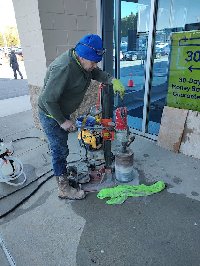


The short answer is No. Stand beside it.
How to safety stand on your core drill rig.
This is a updated post from one of our older websites in Charlotte, NC. Sometimes it is necessary to update a post based on the amount of response we receive back on a particular aspect of core drilling. This is one of them. No other website would tell you that to stand on your core drill rig while core drilling a hole in concrete. We won't either. but there are going to be many instances where a seemingly simple process becomes complex when you have to drill a large hole and way way to mount, anchor, roof jack or vacuum down to the drilling surface in order to complete the task.
Disclaimer
These following methods are definitely non standard, and possibility dangerous to attempt or implement at any level of experience. When core drilling any slab, sidewalk or floor if possible always use built in safety measures as stated in the manual that accompanied the rig and drill motor when purchased or rented. Use this advice only if you are an experienced core drill operator, and then only at your own risk.
What if I can not use a traditional way to anchor or vacuum base my core drill rig to the concrete?
If you are a core drill operator for very long you are going to find out that every job, though similar in a lot of cases, is different in many others. Sometimes in a days work you may be asked not to attach a concrete anchor into the floor or get vacuum on the floor to suck the core drill base to the floor for various reasons. We have found that more often than not our task that day will include areas we have to free style drill the core drill hole. It is always best to have a plan and a well laid out method for doing free style drilling and the picture above best demonstrates the way to accomplish this. Never actually stand on your core drill rigs base when drilling. Always prepare to have a finger on the power switch to immediately cut the power off. It does not take but a second for the rig to suddenly spin faster than you can react. In a perfect world the vacuum base attached to the core drill rig would suck the core drill down tight every where you needed to core drill a concrete hole. But it don't and won't in every situation. If the concrete is smooth and relatively flat the vacuum base will suck down to the concrete surface and hold the drill perfectly still and rigid while you drill the hole. But often this is not the case. Some simple and usually easy items to find to fix this problem may be mud. Mud can be used to pack around the bottom of the core drill base where the rubber gasket could be losing vacuum. This trick works good where line breaks are in the concrete. Otherwise you may be in an area trying to core drill where the vacuum base just won't work. If this is the case you can remove the vacuum base altogether and use a 4 to 5 inch concrete wedge anchor, or even a 1/4 inch x 4 inch masonry screw, to hold the core drill rig in place while you core drill. Tools for this task would be a hammer drill, hammer, wedge anchor and socket set or crescent wrench to tighten the anchor down. If you are planning to remove the wedge anchor after you have drilled a grinder may be needed too. This method works great where you can not get vacuum to the concrete. But wait. What if you can't get vacuum and can for some reason use a wedge anchor to fasten the core drill down? Well... Stand on it. Or better yet, NEXT to it. This is probably breaking the #1 rule that is posted on each core drill when sold new and definably in the core drilling manual. But at time it is the only thing that will really work. Of course when even breaking the rules there are some basic's you should pay attention to. Especially if you are core drilling on a balcony or dangerous place.
Some simple rules to follow.
- A ) Always stand to the left of the drill. The Core drill motor spins the core drill bit clockwise. If the core drill bit gets hung up for some reason the core drill rig will always spin to your right side.
- B ) Position the power cord tight to the left under your boot so that if the core drill does spin the power will disconnect itself and stop the drill from turning. For this reason don't use locking electrical plugs ONLY. If you are able use electrical adapters that will let the power cord totally disconnect from the core drill power box or motor if the drill starts to spin away from your very stout left foot on the power cord.
- C ) Do Not apply too much pressure while free styling it and let the base of the rig rise up in front. Easy does it.
- D ) Do not try this with core drill motors that are rated over 15 amps. Well I had to say it anyhow. 15 amp motors are usually for drilling 3 inch and smaller holes in concrete. 20 amp motors for 3 inch and above. So it is harder to stop a 20 amp machine that can bore a 12 inch hole because of the additional horsepower needed to turn the weight of the bit.
- E ) Do not ever actually stand on your core drill rig, stand beside it.